During a joint operation against the KNF (Kuki National Front) in Ruma, Bandarban, one person was killed in military gunfire. The incident took place on Tuesday (May 7, 2024) afternoon in the area near Keokradong Hill adjacent to Darjeeling Para, Ruma upazila, as reported by the police. However, although the police referred to the deceased as a ‘KNF member’, they could not confirm his identity.
Shahjahan, the OC of Ruma Police Station, confirmed the incident, stating, “An incident of ‘gunfire’ occurred with KNF members in the Darjeeling Para area of Ruma upazila in a joint operation. Later, the body of a KNF member was recovered from there and brought to the hospital. However, the identity of the deceased is still unknown. Details will be known after the post-mortem.”
He also mentioned the recovery of several “weapons and explosives” from the scene.
Meanwhile, it has been learned that this morning, the military took everyone from a bomb family in Darjeeling Para to custody. Many have expressed doubts about whether they were killed in a staged ‘gunfight’.
KNF, through their managed Facebook page, identified the deceased as Nimun Bom (40) and stated that he was the owner of a resort in Darjeeling Para of Keokradong Hill. They claim that he was killed in crossfire by the military in their hideout. However, villagers have claimed, “During Friday prayers, the joint forces shot him.” KNF also confirmed that the deceased was not a member of KNF and there were no clashes or gunfights with the military.
On the other hand, no detailed information has been obtained about the 21 villagers who were arrested from Paikhyang Para on May 2.
According to locals, at least 5-7 people were shot dead in cold blood among those detained that day. Although the body of one person has been recovered from there, it is not known what happened to the others.
It is noteworthy that since April 2-3, a joint operation led by the military against the KNF has been underway in Ruma, Thanchi, and Rowangchhari upazilas focusing on the bank robbery incident. This operation has resulted in arrests, disappearances, and incidents of murder.
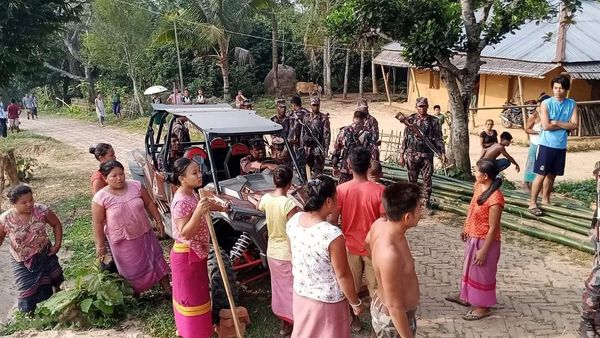
The Bangladesh army is building border highways and linking roads in the Chittagong Hill Tracts (CHT) by uprooting the native Jumma communities, demolishing Jumma homes and plantations, hindering Jum cultivation, and preventing Jum construction at nearby areas of roadways. One of the most recent instances of this is the plot by the 26 Engineer Construction Battalion of the 34 Engineer Construction Brigade of the Army to drive out 23 families and prevent the Jum cultivation of two Gachbagan Para and Thum Para on the border of Jurachari and Bilaichari in the Rangamati district. The Jumma villagers were notified on March 9, 2024, by a group of soldiers under the command of Captain Kabir, the Commander of Chaichal Project Camp, and Subedar Priya Ranjan Chakma, that they would be erecting a Between Thum Para and Gachbagan Para, at Pilar Chug and Langel Tila, is a tourism center. Jum growing is prohibited there and in the adjacent areas, and preliminarily prepared jums cannot be burned for final preparation. As a result, the residents of these two villages will have to relocate. The Army issued a severe warning if they didn’t comply.
Then, on March 11, 2024, the army began using excavators to level the hills in Pilar Chug and Langel Tila, demolishing Buddhalila Chakma’s jum-farm in the process. Earlier, on March 6, the army used an excavator to destroy Birasen Tanchangya’s Jum-farm. On March 12, 2024, Karbari (village head) Thudo Chakma of Gachbagan Para village was ordered to produce a list of Jums by Captain Kabir, the commander of the Chaichal army camp, and Subedar Priya Ranjan Chakma. Thudo Chakma was also informed by Captain Kabir Karbari, “You must depart the village regardless of whether you give the list of Jums or not.” Opposing the government’s choice has never helped anyone. So you leave the village and move somewhere else, rather than defying the authority. These peasants who have received instructions too depart the village are now extremely nervous and afraid.
The people of two villages staged a human chain at the south gate of the Rangamati Deputy Commissioner’s office on March 19, 2024. The villagers demanded that the 26 Engineering Construction Brigade of the Army stop evicting the villagers of Gachbagan Para and Thum Para on the Jurachhari-Bilaichhari border in a memorandum submitted to the Prime Minister through the Deputy Commission of Rangamati district.
The locals said in the memorandum that cultivating jum is their primary source of income. Many of them have created banana plantations, mango-jackfruit plantations, and tiger grass plantations in the last 24 or 25 years. Many villagers also planted ginger, turmeric, sesame, pepper, and other herbs in addition to paddy. Additionally, it is stated that the Jumma villages of Shukkarchari, Changrachari, Dulubagan, Mandirachara of Bilaichari, and Mandirachara of Jurachhari will all be forced to leave if the tourist center is built and the aforementioned two villages are forced to leave as well.
The villagers made four demands: they demanded that the order to evict the residents of Gachbagan Para and Thum Para be rescinded; they demanded that tourist attractions not be built close to indigenous villages; they demanded that any obstacles to Jum cultivation be removed; and they demanded compensation for the affected indigenous families. It is encouraging that the army permitted the locals to plant Jum and set fire to Jum that had been partially prepared following the protest. The order to evacuate the village has not yet been rescinded by the army, though.
in around 3 p.m. on March 8, 2024, a senior army official paid a visit to the army camp in Chaichal. The following day, March 9, army soldiers from Chaichal camp went to the hamlet and told the Jumma villagers of Gachbagan Para and Thum Para that 12 families from Gachbagan Para had to leave the area because the army leader had given the order to discontinue Jum cultivation.
It should be mentioned that the Bangladesh Army is building a 317-kilometer border road along the borders with India and Myanmar, passing through the mountainous districts of Rangamati, Khagrachari, and Bandarban. In addition, there are other roads that connect to it. These include the following linkages: Sijakchara to Sajek-Shilda-Betling; Rajasthali-Bilaichari-Jurachari-Barkal-Thegamukh; Alikadam-Kurukpata-Poamuhuri; and Link road from Ugalchari village to Majhipara under Baghaichari upazila.
The construction of a border road under the direction of the Bangladesh Army has resulted in massive deprivation, eviction from their ancestral land, and massive loss of fruit plantations, forests, and land property for the indigenous Jumma people who live in three hill districts of CHT. The viewpoints of the local community, including the CHT Regional Council and the three Hill District Councils, were disregarded prior to the project’s adoption and implementation, and the rights of the affected residents to compensation and human rights were violated.
According to reports, this border road and connection road project has caused at least 776 Jumma families in three hill districts (Rangamati, Khagrachari, and Bandarban) to suffer significant harm, and at least 78 families have been forced from their homesteads and communities. It’s possible that additional families will be impacted. The most recent instance of this type of eviction is a plot to force 23 Jumma families from Gachbagan Para and Thum Para in the Upazilas of Jurachari and Bilaichari. Among 776 Due to widespread demonstrations, just 56 families in the Baghaichari area have gotten some compensation. The others were not paid. “Country is ours, land is ours, why should we give compensation?” the military sarcastically responds when the impacted families ask for compensation.
The construction of camps and visitor centers is now one method of land dispossession in the CHT. Similar to how army and BGB (Border Guard Bangladesh) camps are erected everywhere for security reasons, they also seize land and hills and build opulent tourist destinations in an attempt to capitalize on the initiative to build a border road. For instance, in the Kamalak area of Sajek Union in Baghaichari, six families’ land was taken by force in order to build a BGB camp. After seizing the land from the Jumma peasants, an army camp was established in a location known as Sijakachara Mukha, while another army camp was established near Udaipur.
Additionally, under the Baghaichari upazila, five army camps are to be established between Sijakchara and Udaipur. The fruit plantations of the Jumma villagers in Ghilatuli village, Logang union, Panchari upazila, Khagrachari district, have been taken over by a BGB camp. During the border road’s construction, the Dumdumya Union of Jurachari’s Chaichal army camp was also constructed.
In an attempt to expropriate the land next to the border road and the surrounding areas, the warrant officer of Chaichal army camp Saiful is coercively attempting to get signatures from the headmen of the local Gandachara Mouza Sangur Pangkhua and the headman of Rengkhyong Chongrachari Mouza Balabhadra Chakma, claiming that these lands and hills are Khas land (Government land). There isn’t any Khas land in CHT, nevertheless, according to the traditional land management system there. It is believed that the hills and fields that the army designated as Khas lands belong to the indigenous Jumma people and are owned by the Mouza group.
In addition, the army and BGB authorities chose numerous picturesque locations next to the road and occupied them, marking them with signs as “protected areas” in order to establish tourism hubs during the construction of the border route and the connecting road. In addition to forcing the Jumma villagers to leave their homes and plantations and preventing them from constructing new homes near existing highways, the border and connection roads also devastated the local woods, ecosystem, and wildlife. The careless extraction of stones from streams for road building is destroying water sources. As a result, many places are experiencing a drinking water crisis.
Additionally, there are claims that the army has installed signboards with Muslim names in opposition to the native names of the Jumma people at numerous locations along the border route and connection roads. Examples of such are “Shaheen Tila” in Sarbowatli union of Baghaichari, “Mahmud Tila” in Sajek union, “Enamul Tila” in Sajek union, “Sajib Tila” in Sajek union, “Shamim Tila” at Kingkar Para, “Saidur Tila” at Bhuyochara in Sajek union, “Ismail Tila (BOP Post)” at Kingkar Para in Sajek union, “Al-Amin Tila” at Bhuyochara in Sajek union, etc.
This may be seen as a component of the Jumma people’s severe Islamic expansionist hostility against them as well as a larger plot to eradicate their customs and native name. It can also be argued that, by implementing this border road and link road project indiscriminately, the government and the army are completely disobeying the CHT Accord’s commitment and provisions to preserve the characteristics of Jumma (tribal) inhabited areas in the CHT region, thereby undermining those characteristics.
In addition to the current crisis brought on by the non-implementation of the CHT Accord, which includes unresolved land disputes and the non-implementation of the special governance system to be introduced in light of the CHT Accord, the local Jumma people fear that the construction of the border road project will cause extensive harm to the indigenous Jumma people. Above all, the army and government’s anti-Jumma and anti-interest roles will exacerbate the processes of outsider infiltration, cultural invasion, outsider capital dominance, land dispossession, and native alienation, making it extremely difficult for the Jumma people to maintain their traditions, culture, and self-governance.
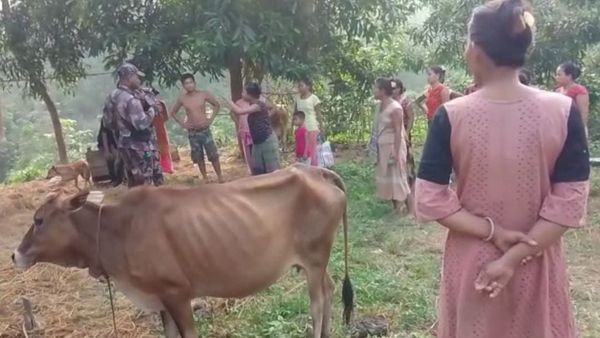
June 5, 2023 Khagrachari, There have been complaint of BGB (Border Guard Bangladesh) attempting to forcefully stealing the domestic cows of the jumma villagers from the border village, from the border village of panchari upazila in Khagrachari district of Bangladesh,
Later in the face of villagers from the local peoples, the BGB personnel were compelled to leave the cows and return to the camp.
5th June 2023 morning time a group of BGB members from dine Chandabari camp of BGB( border guard Bangladesh) came to the border village of Dhudhukchara area villages of panchari upazila of Khagrachari, at this time they tried to stealing the cows of the some villages , being angry of this , all the men and women of the area protested and resisted such unjust actions of BGB. Later in the face of massive villagers from the village , the BGB personnnel were compelled to leave the cows and return to the camp.
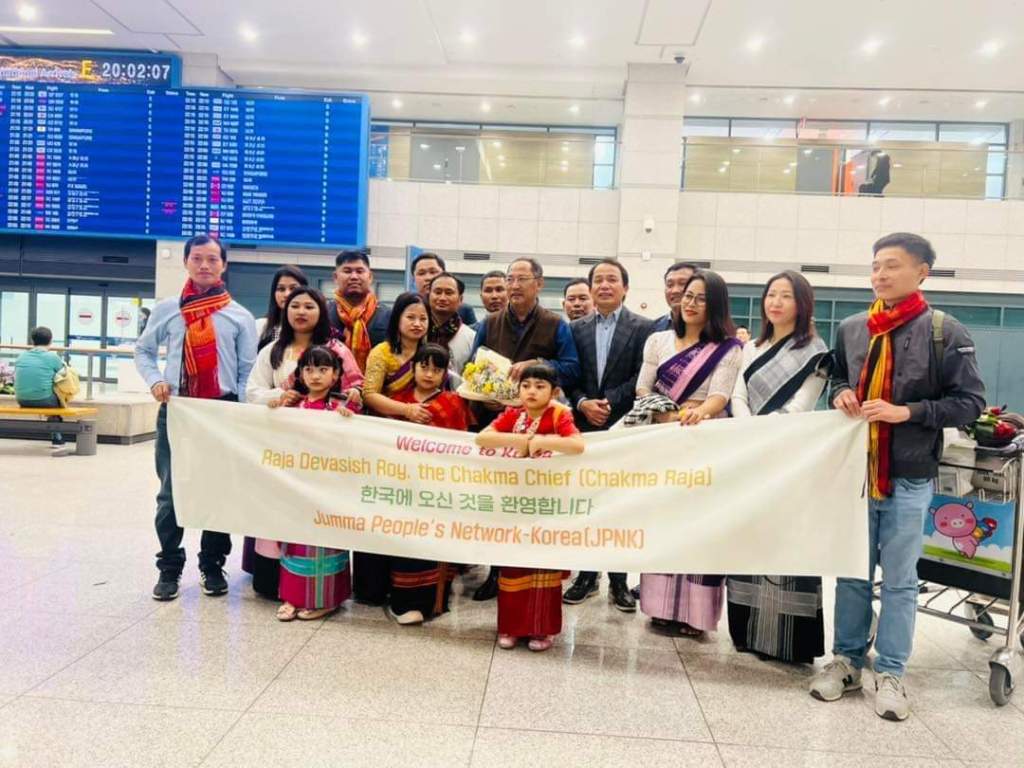
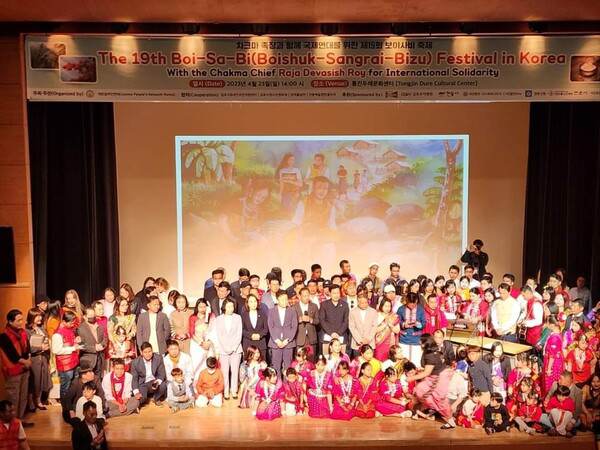
The chakma circles chief Berrister Raja Devashish Roy, he has to come to south Korea on 21th April to participated Boi Sa Bi festival which is organization by Jumma peoples,s Network Korea (Jpnk ) its a 19th Boi sa bi festival 2023 on 22 and 23 April, of this festival has invited chakma circles chief, on behalf JPNK executive member Sajib Chakma, kabaleshwar chakma, Aungshapru Marma , on behalf senior member Ronel Chakma , Zidim chakma Family, proggadeep chakma Family and sotez chakma family, Giti chakma Jamuna chakma Riken chakma,and Hittw chakma went to airport to welcome our Honorable guest Berrister Raja Devashish Roy,
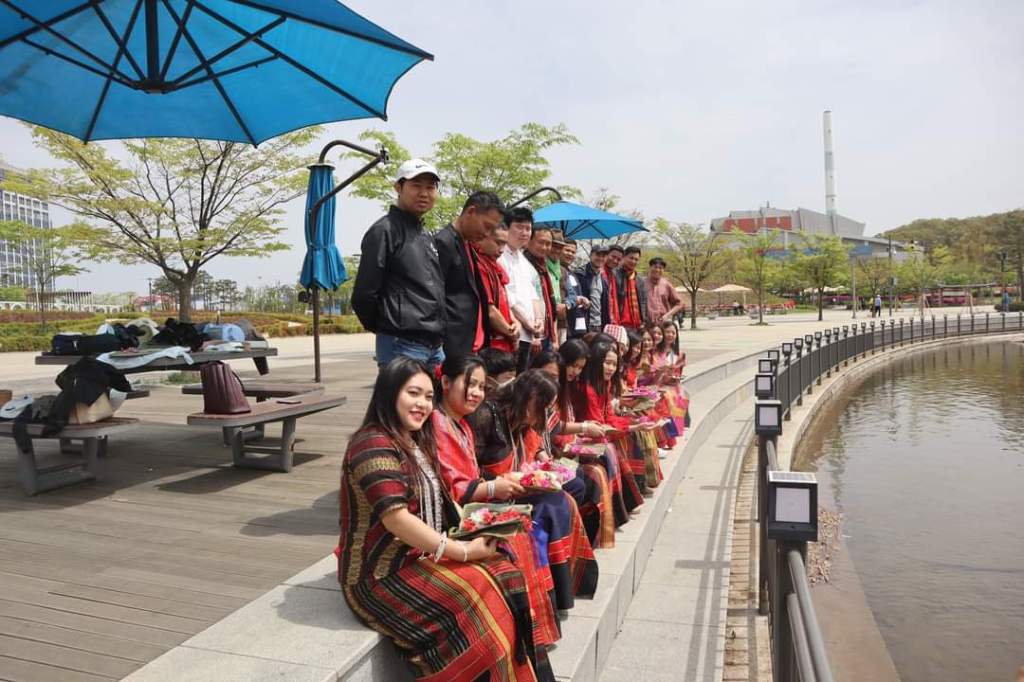
22th april on Saturday around 10 AM jumma community with Raja Babu together went offer flower to the river , chakma community has a history to offer flower to the river , they are hard working in the year end of the years day before two day chakma community offer flower to the rover its means they said to good bye all kind of suffering end of the years shearing their happiness with all villagers and neighbors
After flower offering JPNK Executive member Nikhil chakma, Sajib chakma, kabaleshwar chakma anymoy chakma shopping for main program , after shopping around 7 PM youth and JPNK Executive member together in JPNK office and preparation foods for boi sa bi program,
On 23 April around 9 AM morning time JPNK Executive member Nikhil chakma, Kabulashwar chakma , sajib chakma , Anymoy chakma and EX president Ratna kitti chakma went to program hall to preparation program hall and foods stall, and finally BOI SA BI program stared around 1:30 PM, of this BOI SA BI festival we has been included cultural program specially of jumma children and this cultural program lead by jenifa rava, lika chakma and rupa tangchngya thanks to her on behalf JPNK 2023 BOI SA BI program invited chakma circles chief , Gimpo city hall mayor, Korean NGO and Korean civil society all guest invited by JPNK advisor Ronel chakma with out him JPNK Executive Member can’t invited them.
copy rights CHTC 12 April 2023 The International Chittagong Hill Tracts Commission (CHTC) is deeply concerned about the death of eight indigenous Bawm men in an alleged ‘gunfight’ at Rowangchari Upazila in Bandarban on 6 April 2023.
Quoting security officials, various media reported that all the killed persons belong to the indigenous Bawm Christian community and are members of the Kuki-Chin National Front(KNF)1. They allegedly died when a gunfight broke out between KNF and UPDF (Democratic)2. Newagebd further mentioned that the KNF denied the deceased to be their members, and they claimed that the victims were innocent villagers3. Meanwhile, on 9 April 2023, the United Workers Democratic Front, Greater Chittagong HillStudents’ Association, Hill Women’s Federation, and Democratic Youth Forum organized aprotest rally in Dhaka against the incident. They alleged that in the early morning of 6 April 2023, state-sponsored vigilante groups kidnapped 22 unarmed local Bawm villagers from Jurbharang Para of Paindu Union in Ruma. After keeping them hostages at a local school, the vigilante group executed eight Bawm villagers and released the rest. The speakers further claimed that mainstream media is trying to hide the truth.4 Humanity Protection Forum, a human rights organization based in Tripura of India, in a press statement – claimed the same. If these allegations are indeed true, this is a deliberate and targeted massacre against the Bawm community, one of CHT’s smallest indigenous groups. The CHTC demands an immediate and impartial judicial investigation into the exact circumstances of the events. For a long time now, the Parbatya Chattagram Jana Sanghati Samity (PCJSS) and the United People’s Democratic Front (UPDF), the two leading political parties of CHT, have been alleging activities of various state-sponsored vigilante groups in CHT who want to foil the implementation of the CHT Accord. According to their reports, 44 members of UPDF and 32 1 https://www.prothomalo.com/bangladesh/district/vea32mof4i 2 https://www.thedailystar.net/news/bangladesh/crime-justice/news/8killed-shootout-bandarban-3291511
4 https://bangla.thedailystar.net/news/bangladesh/news-468861 members of PCJSS were killed between 2017-2021 by these vigilante groups. Further, recently, on 2 April 2023, Hlaching Mong Marma (Usha), a Jumma political activist, was allegedly tortured to death by the Bengali settlers in Manikchari Upazila of Khagrachari district, and on 4 April 2023, Tridiv Chakma, another political activist was shot to death by vigilante groups in Dighinala Upazila of Khagrachari5 . The two political parties have also reported numerous incidents of harassment, torture, illegal detention, and arrests by security forces in the last few years. Last month, two Parbatya Chattagram Pahari Chatra Parishad (PCP) activists were released on bail from the Bandarban jail on 15 March 2023 and were allegedly re-arrested by the military from the jail gate6 . The CHT Commission is very alarmed at all this unrest unfolding in CHT and the continued human rights violations. We believe this results from the non-implementation of the CHT Accord even after a quarter-century of its signature. To ensure long-lasting peace and stability in CHT, we recommend the following to the government of Bangladesh:
To initiate a judicial investigation into the killing of eight Bawm Indigenous men, identify the perpetrators, and ensure justice.
To ensure the safety of the local Bawm Indigenous community and take immediate measures to bring back a few hundred Bawm refugees who have fled to India since last October and provide urgent support to the people who have been internally displaced.
To stop criminalizing Indigenous rights activists, withdraw all the fabricated court cases filed against them, and allow them to return to normal life.
To conduct impartial and prompt investigations into the continued alleged human rights violations in CHT and ensure justice to the victims and accountability for those responsible.
To demilitarize the CHT and to take steps to fully implement the 1997 CHT Accord and prevent all types of anti-accord directives and activities. On behalf of the CHT Commission,
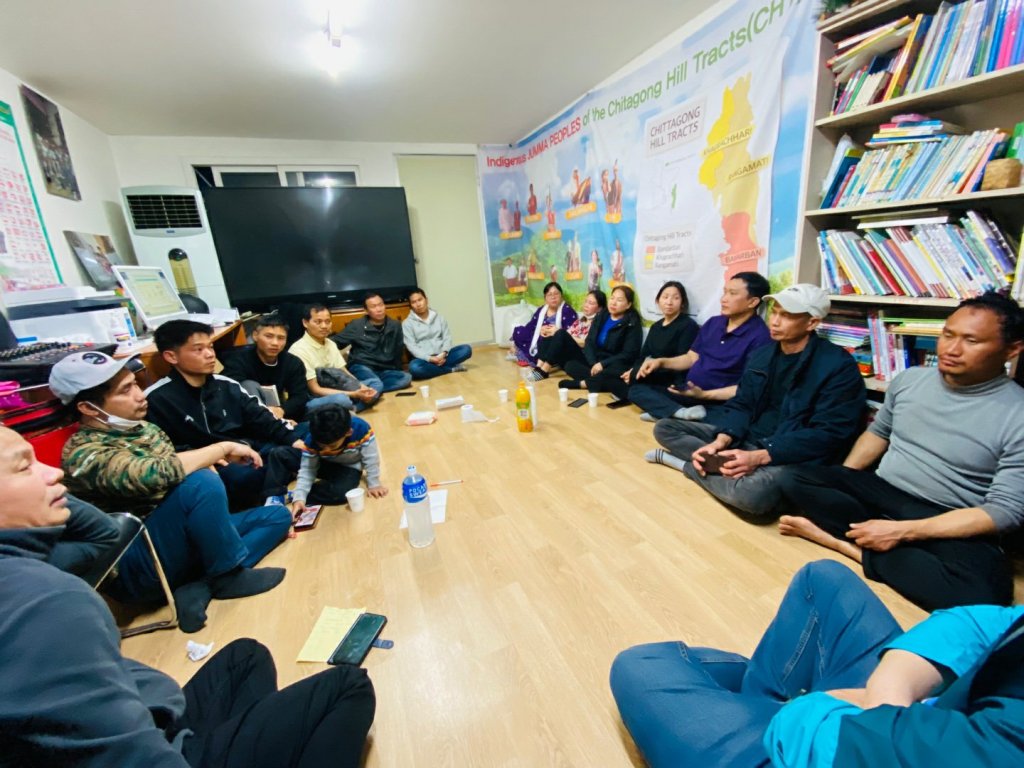
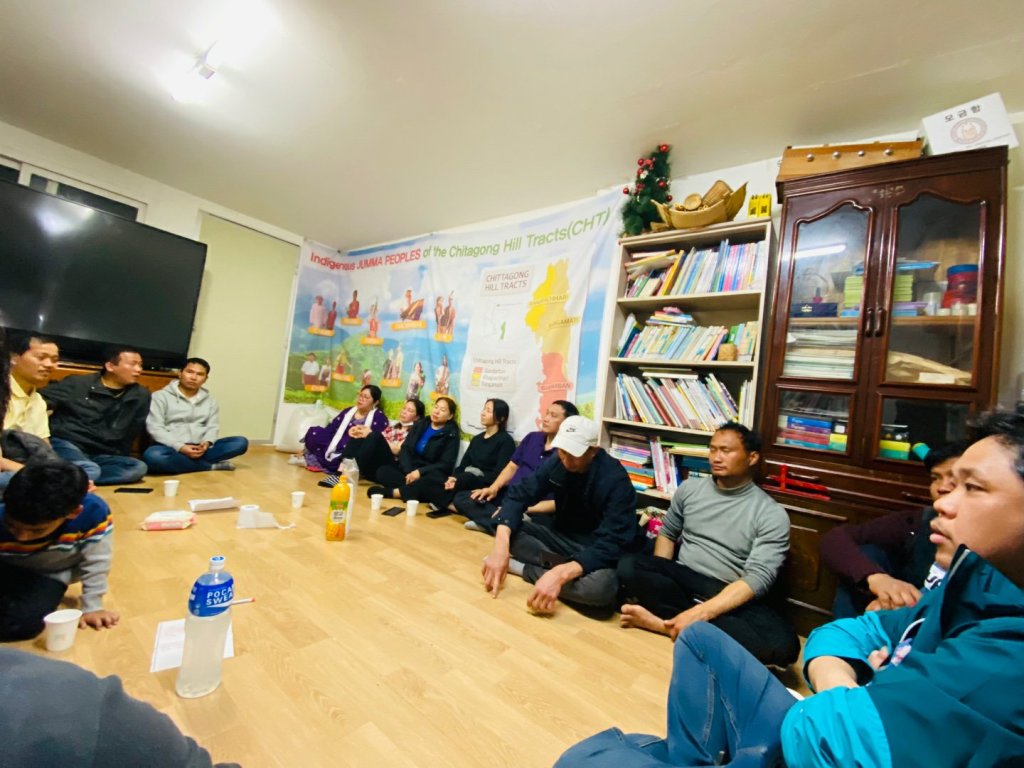
On 2th April 2023 on Sunday in jpnk office around 7 Pm at evening jpnk organized a Boi-Sa-Bi meeting for about Boi-Sa-Bi schedule and chakma circle chief Barrister Devashish Roy (chakma Raja)
Here is jpnk organized committee executive members are divided duty to the jumma community for upcoming Boi-Sa-Bi festivals,
On that jpnk meeting special discussion and explanation for chakma 🤴 after came to korea to till back to Bangladesh,
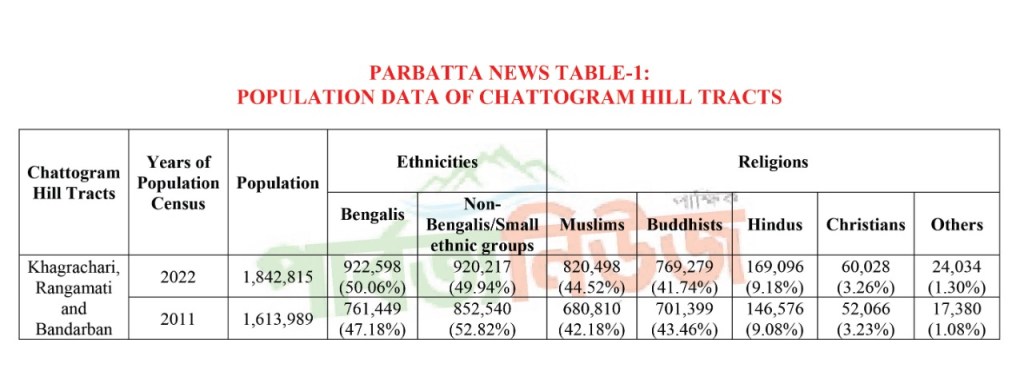
A comparative analysis of the preliminary report of the Population and Household Census 2022 recently released by the Bangladesh Bureau of Statistics (BBS) and the census report of 2011 shows that the Bengali population has increased while the non-Bengali/small ethnic population has decreased in Chattogram Hill Tracts. According to the preliminary report of the 2022 census, the combined population of the three hill districts, namely Khagrachari, Rangamati, and Bandarban, is 1,842,815. Of them, 922,598 (50.06%) are Bengalis, and 920,217 (49.94%) are non-Bengali/small ethnic people. The 2011 census report showed the total population of the three hill districts at 1,613,989. Of them, 761,449 (47.18%) are Bengalis, and 852,540 (52.82%) are non-Bengali/small ethnic people. That is, compared to the census of 2011, the percentage of Bengali people has increased by 2.88% while that of the non-Bengali/small ethnic people in Chattogram Hill Tracts has decreased by 2.88%.
According to the preliminary report of the 2022 population census, Muslims in the three hill districts make up 820,498 (44.52% of the total population there), Buddhists 769,279 (41.74%), Hindus 169,096 (9.18%), Christians 60,028 (3.26%) and others 24,034 (1.30%). According to the 2011 population census, there were 680,810 Muslims (42.18%), 701,399 Buddhists (43.46%), 146,576 Hindus (9.08%), 52,066 Christians (3.23%), and 17,380 others (17.08%). In other words, the number of Buddhists has decreased in the Chattogram Hill Tracts while the number of Muslims, Hindus, and Christians has increased. Even those who do not practice any of the four mentioned religions (nature worshippers) have increased in number. According to the latest available data, the number of Buddhists in the Chattogram Hill Tracts has increased by 67,880 since 2011, but the overall percentage has decreased by 1.72%. On the other hand, the Muslim population has increased by 139,688 people, or 2.34%. The Hindu population has increased by 22,520 people, or 0.1%. The number of Christians has increased by 7,962 and by 0.03% in percentage terms. Other (nature worshippers) religions’ adherents have increased by 6,654 or by 0.22%.
The three hill districts cover approximately 13,191 square kilometers, accounting for 11.19% of the country’s total area of 147,570 square kilometers. The total population of the three hill districts, on the other hand, is 1,842,815, or 1.16% of the country’s total population of 165,158,616. That is, the Chattogram Hill Tracts, or CHT, which covers 11.19% of the country, is home to 1.16% of the total population.
KHAGRACHHARI POPULATION
According to the preliminary report of the population census 2022, Khagrachhari has a total of 714,119 people. There are 364,741 Bengalis (51.08%) and 349378 non-Bengalis/small ethnic people (48.92%) among them. Of them, Muslims make up 332,494 (46.56%), Buddhists 256,512 (35.92%), Hindus 119,615 (16.75%), Christians 4,428 (0.62%), and others 1,143 (0.16%). The population density in Khagrachari district is 260 per square kilometer, and the literacy rate is 71.73%. According to the 2011 census report, Khagrachari had a total of 613,917 people. Of them, there were 296,930 Bengalis (48.37%) and 316987 (51.63%) non-Bengali/small ethnic people. Of them, Muslims made up 274,258 (44.67%), Buddhists 231,309 (37.68%), Hindus 103,195 (16.81%), Christians 4,070 (0.66%), and others 1,085 (0.18%). In 2011, the population density in Khagrachhari district was 223 per square kilometer, and the literacy rate was 46.1%.
RANGAMATI POPULATION
Rangamati district has a total population of 647,587 people, according to the preliminary report of the census 2022. There are 274,723 Bengalis (42.42%), and 372864 non-Bengali/small ethnic people (57.58%). Of them, Muslims make up 234,556 (36.22%), Buddhists 370,744 (57.25%), Hindus 33,027 (5.10%), Christians 8,548 (1.32%), and others 712 (0.11%). The population density in Rangamati district is 106 per square kilometer, and the literacy rate is 71.33%. Rangamati had a total of 595,979 people, according to the 2011 census. There were 239,826 Bengalis (40.24%) and 356,153 non-Bengalis/small ethnic people (59.76%) among them. Muslims made up 209,465 (35.15%), Buddhists 347,038 (58.23%), Hindus 302,44 (5.07%), Christians 8,663 (1.45%), and others 569 (0.10%). Rangamati district had a population density of 97 per square kilometer in 2011 and a literacy rate of 49.7%.
BANDARBAN POPULATION
According to the preliminary population census 2022 report, the total population of the Bandarban district is 481,109 people. There are 283,134 Bengalis (58.85%) and 197,975 non-Bengalis/small ethnic people (41.15%). Of them, Muslims make up 253,448 (52.68%), Buddhists 142,023 (29.52%), Hindus 16,454 (3.42%), Christians 47,052 (9.78%), and others 22,179 (4.61%). The district of Bandarban has a population density of 107 per square kilometer and a literacy rate of 63.64%. Bandarban had a population of 404,093, according to the 2011 census. There were 224,693 Bengalis (55.60%) and 179,400 non-Bengalis/small ethnic people (44.40%) among them. Of them, Muslims made up 197,087 (44.77%), Buddhists 123,052 (30.45%), Hindus 13,137 (3.25%), Christians 39,333 (9.73%), and others 15,726 (3.89%). Bandarban district had a population density of 87 per square kilometer in 2011 and a literacy rate of 31.7%.
A COMPARISON OF THE POPULATION OF CHATTOGRAM HILL TRACTS WITH THE REST OF THE COUNTRY
An analysis of some data from the preliminary report of the census 2022 – comparing the population of Chattogram Hill Tracts to the entire country – has yielded some extraordinary results. In comparison to the rest of the country, the population density in the Chattogram Hill Tracts is very low. In comparison to the country’s average of 1,119 people per square kilometer, 979 live in Chattogram division, 260 in Khagrachari, 106 in Rangamati, and 107 in Bandarban. The literacy rate in the Chattogram Hill Tracts (Khagrachari 71.73%, Rangamati 71.33%, and Bandarban 63.64%) is nearly equal to the national literacy rate (74.66%), and is higher than the literacy rate in the Mymensingh division (67.09%). The rate of homeless floating population in the Chattogram Hill Tracts (0.01% in Khagrachari, 0.008% in Rangamati, and 0.02% in Bandarban) is lower than the national rate (0.01%). Rangamati (0.94%) and Bandarban (0.0004%) have fewer slum dwellers than the rest of the country (1.10%), but Khagrachari (1.18%) has more and it is most likely due to the large Bengali population living in the slums of Khagrachari’s cluster villages. Although cluster villages exist in Rangamati, they are few in number, and Bandarban has no slum dwellers due to the lack of cluster villages. In the Chattogram Hill Tracts, fewer people live in rural areas than in the rest of the country (58.24% in Khagrachari, 52.40% in Rangamati, and 59.52% in Bandarban). People from the Chattogram Hill Tracts, on the other hand, live in urban areas at a higher rate than the national average (31.49%). This could imply that the people of the Chattogram Hill Tracts are becoming more interested in modern urban life rather than earning a living by cultivating jhum (shifting cultivation) in the hilly areas. The three hill districts, on the other hand, have 101 hijras (people of the third gender).
Indigenous Peoples The Indigenous community of the CHT experienced widespread discrimination and abuse despite nationwide government quotas for participation of Indigenous CHT residents in the civil service and higher education. These conditions also persisted despite provisions for local governance in the 1997 CHT Peace Accord, which has not been fully implemented, specifically the portions of the accord empowering a CHT-specific special administrative system consisting of the three Hill District Councils and the Regional Council. Indigenous persons from the CHT were unable to participate effectively in decisions affecting their lands due to disagreements regarding land dispute resolution procedures under the Land Commission Act. Local organizations claimed the army and intelligence forces carried out extrajudicial killings and arbitrary arrests; beat, harassed, threatened, and jailed Indigenous people on false charges; and labeled rights activists as terrorists and extortionists. In July the government ordered media not to use the word “indigenous” in shows organized for the August 9 International Day of the World’s Indigenous Peoples
Indigenous activists claimed ethnic minorities were drastically undercounted by the census, impacting land rights and the development budget of the CHT. The official census reported 1.65 million minority persons, while the Bangladesh Indigenous Peoples’ Forum estimated there were around three million ethnic minority persons. While the country had a 20 percent poverty rate, poverty in the plains, where some Indigenous persons lived, was more than 80 percent and more than 65 percent in the CHT. Organizations corroborated health care available to Indigenous persons was well below the standard available to non-Indigenous persons in the country. Throughout the pandemic, multiple NGOs reported severe food insecurity due to the abrupt job loss by Indigenous persons outside the CHT. Since many Indigenous persons most in need of assistance lived in remote areas difficult to access by vehicles, many Indigenous communities reported receiving no government assistance.
Human rights organizations continued to allege evictions and communal attacks occurred against local populations in the CHT, often at the direction of the government, army, and intelligence agencies. In September reports emerged that a rubber plantation had poisoned the water source of several villages to displace the local Indigenous population from its land. In August the UN special rapporteur on the rights of Indigenous peoples; the UN Working Group on Arbitrary Detention; the UN special rapporteur on extrajudicial, summary, or arbitrary executions; and the UN special rapporteur on the promotion and protection of the right to freedom of opinion and expression wrote to the government with concerns regarding the alleged torture and subsequent death of Nabayan Chakma Milon, an Indigenous political activist, in military custody. They called for an immediate investigation into Milon’s death. The United Nations noted “it has been brought to our attention that the Indigenous peoples and Indigenous rights activists, as well as Indigenous political activists have repeatedly been subjected to alleged arbitrary arrest, torture, arbitrary deprivation of life and enforced disappearance in CHT. Moreover, almost every time a raid took place in CHT area by the military personnel, the legal requirements such as obtaining warrants for search, arrest, or both were not being followed.” Indigenous communities in areas other than the CHT reported the loss of land to Bengali Muslims, and Indigenous peoples’ advocacy groups reported deforestation to support Rohingya refugee camps and other commercial pursuits caused severe environmental degradation in their land, adversely affecting their livelihoods.
The central government retained authority over land use. In what local rights groups deemed a blatant land grab, Lama Rubber Industries Limited filed a case in August in the Senior Judicial Magistrate Court of Bandarban against 11 villagers who demanded protection of 400 acres of their farmland and rural forest.
Indigenous communities, organized under different political groups, engaged in violence within the Indigenous community. The factional clashes between and within the United Peoples’ Democratic Forum and the Parbatya Chattagram Jana Samhati Samiti resulted mostly from the desire to establish supremacy in particular geographic areas. Media reported many leaders of these factions were engaged in extortion and smuggling of money, drugs, and arms. Meanwhile, the deaths and violence remained unresolved. NGOs and Indigenous persons familiar with the situation warned intraparty violence in the CHT had risen sharply. Reports of sexual assaults on Indigenous women and children by Bengali neighbors or security personnel remained unresolved.
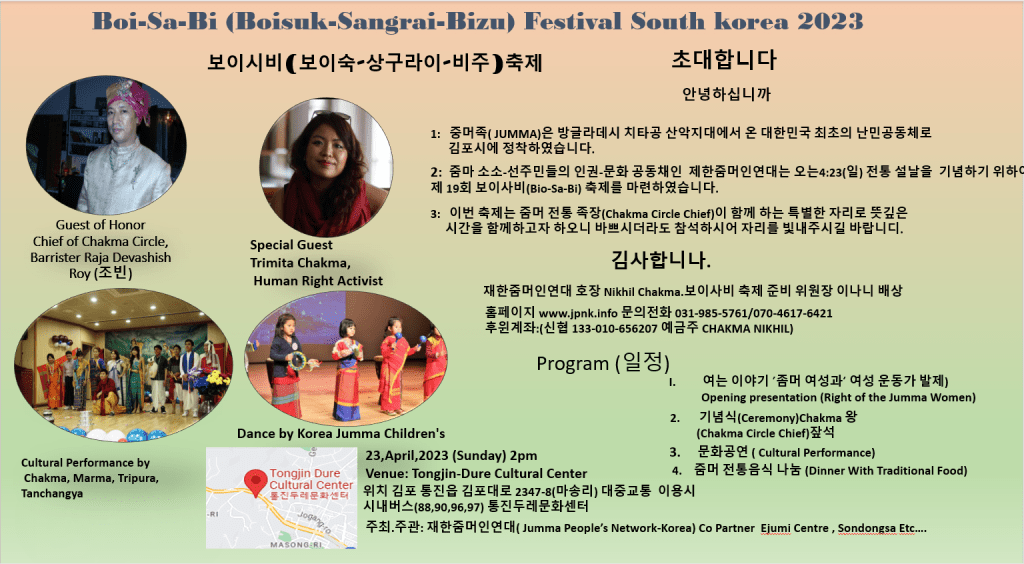
Jumma Peoples Network South Korea going to organized Boi-Sa-Bi festival after covid19 be normal on 23th April 2023( Sunday) at 2 pm. Venue is Tongjin dure culture center (위치 김포 통진읍 김포대로2347-8( 마송리) 대중교통이용시 시내버스(88,90,97) 통진두레문화센터.
This Boi-Sa-Bi festivals is a very important for first time our chakma circle chief Barrister Raja Devashish Roy will participating and Human Rights Activities & Feminist researcher Miss Trimita chakma on this occasion.
On this festival we have to organized our jumma cultural program and songs, chakma, marma, tripura and tangchangya, and jumma children’s dance. And speech from jumma guest and korean guests too.
I am sajib chakma ( jpnk financial secretary on behalf jpnk) inviting to all of you if any one interesting please 🙏 come and watching our Boi-Sa-Bi festivals thank you
It has been reported that a jum farmer was hacked to death in border guard Baramadak area of the Remakri Union of Thanchi Upazila in Bandarban.
last Wednesday (March 15, 2023) morning, the farmer was hacked to death in the Jum field, Thanchi Police Station OC Imdadul Haque said.

The name of the deceased person is Mongkyching Marma (47). He is a resident of Baramadak Bazaar area.
Muishaithui Marma, Chairman of Remakri Union Parishad, said to the reporters in the afternoon, "The villagers reported that a person was hacked to death in the Jum field in the morning. Details are not known due to lack of mobile network.
"It is believed that the he was hacked to death after having an argument with someone in Jum field."

The area is quite remote. The body is being brought to Thanchi Sadar. This local public representative said that it takes four to five hours to reach Thanchi from Baramadak by engine boat.
Thanchi police station OC Imdadul said, “I heard that a person was hacked to death through the public representative. The area is very remote. Details can be told when the body arrives in the evening. Legal action will be taken after that."

Source: bdnews24.com, chtnews,
.jpg)







 CHT Hidden News